Timothy James – Funeral Celebrant
A meaningful farewell is about more than the words that are spoken. It is the music, the atmosphere, the moments of reflection, the people involved, the memories shared and the things left unsaid. Together, they create a ceremony that honours a life and reflects the person at its centre.
WHAT A LIFE WELL TOLD MEANS
It is a life honoured in a way that feels fitting for the person being remembered and for those who’ve gathered to say goodbye to them. Every family is different. Every life is different. There is no single way to create a meaningful farewell.
Ceremony types
A life can be remembered in many ways. Whatever form the occasion takes, the aim is to create something personal, thoughtful and fitting, with the whole ceremony shaped around the person being remembered and the wishes of those closest to them.

Thoughtfully created services at crematoria, churches and other chosen venues.

An opportunity to gather, reflect and remember in your own time.

Simple or more traditional ceremonies shaped around your wishes.
Meaningful moments in places that held significance for the person being remembered.
MY APPROACH
Every ceremony I write and lead is made for one person and used once. Some families know exactly what they would like included. Others are less sure and appreciate help exploring the possibilities. Most are somewhere in between.
One of the things families often discover is how much freedom they have. A ceremony does not have to follow a traditional structure simply because that is how things have always been done.
My role is to listen, open up the possibilities and bring the knowledge, writing and stagecraft that help your family create a farewell that feels right.
HOW IT WORKS
Your family remains at the heart of the decisions, with support and ideas available whenever they are helpful.
In many cases, your funeral director will already have put us in touch. Our first call is usually a practical one: to introduce ourselves, arrange a convenient time to meet and answer any immediate questions. You do not need to have anything prepared or decided before we speak.
Usually we meet in your home, with as many family members and friends as you would like to be there. Some conversations flow easily from the start; others take a little time. Both are perfectly fine. We will talk at a pace that suits you about the person being remembered, the people and experiences that shaped them, and what you would like the ceremony to hold. You decide what feels important and what remains private.
Together, we will consider how the whole ceremony might take shape. That could include music, readings, hymns, poems, photographs, a slideshow, family contributions, moments of silence, symbolic acts or something particular to the person being remembered. I can draw on an extensive range of ideas and examples, while you decide what feels meaningful and right.
When the shape is clear, I prepare the full script and running order, bringing the different elements together so the ceremony flows naturally. You will receive everything in good time to read, reflect on and share. If something does not feel right, we change it. Nothing is final until you are happy.
I arrive early and coordinate the practical arrangements with the funeral director and venue, so those details do not fall to you. I then hold the shape of the ceremony, leaving family and friends free to be present within it. Afterwards, the script is yours to keep and to share with anyone who could not be there.
Your choices
A ceremony can be traditional, entirely non-traditional, or somewhere between the two. Apart from any necessary requirements at the chosen venue, its structure does not have to be fixed.
A spoken tribute, often referred to as a eulogy, may sit at its heart. This might be something you wish me to write and present, or the family may wish to do this themselves. The ceremony might be led largely by music and photographs, by contributions from family and friends, or by a distinctive combination of elements chosen for that person.
Familiar pieces, chosen for memory, meaning or simply because they belonged to that person.
Tributes, readings, poems and personal reflections, written or delivered by whoever feels right.
Familiar or unexpected pieces, chosen for memory, meaning or simply because they belonged to that person.
Photographs, slideshows and visual memories that can carry a ceremony in their own way.
Family and friends involved as much, or as little, as they wish.
Objects, gestures and symbolic acts that hold particular meaning.
Space for silence, reflection and moments that do not need filling.
Faith and belief
How I write ceremonies tends to sit outside religious tradition, though gently so. Should your family wish for hymns, prayers or readings to be part of the day, they’re woven in with equal care.
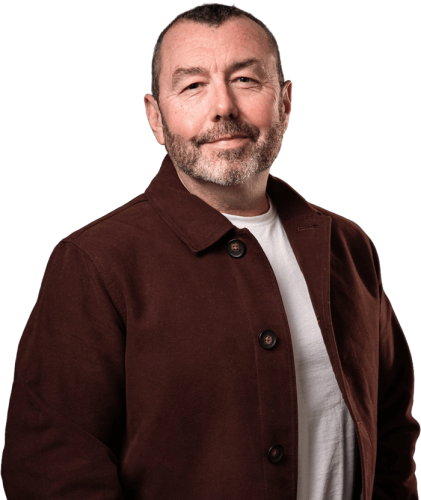
About Timothy James
There are many ways to conduct a funeral ceremony. What matters to me is helping families create one that feels right.
Not simply well organised or professionally delivered, but personal: a ceremony that reflects the person being remembered and the people who loved them. The highest compliment I can receive is hearing someone say, “That was true to who they were.”
I live in Matlock and work with families across Derbyshire and the Peak District. Although I was not born here, this is the place I chose. The river valleys, villages and landscapes of Derbyshire have become part of how I understand home.
Perhaps because I arrived here later in life, I have always been interested in how people are shaped by place, relationships, experiences and the times they live through. That curiosity about people is one of the things that led me to celebrancy.
Before this, I spent over twenty years as a senior manager and coach, much of it listening closely to people’s stories and helping them find the right way to tell them. That’s a different setting to this one, but not such a different skill. A ceremony asks the same question a good conversation always did: who is this person really. I’ve spent a long career learning how to listen for the answer.
I trained through the Level 3 Diploma in Funeral Celebrancy with Civil Ceremonies, and I’m a member of the Institute of Civil Funerals (ICF).
“My role is to listen carefully, share possibilities and help create a ceremony that feels fitting for the person being remembered and the people gathered to honour them.”
Whether your funeral director has put us in touch or you are contacting me directly, you do not need to have everything worked out. Our first call is simply a chance to introduce ourselves, answer any immediate questions and arrange a time to meet.
Member of the Institute of Civil Funerals